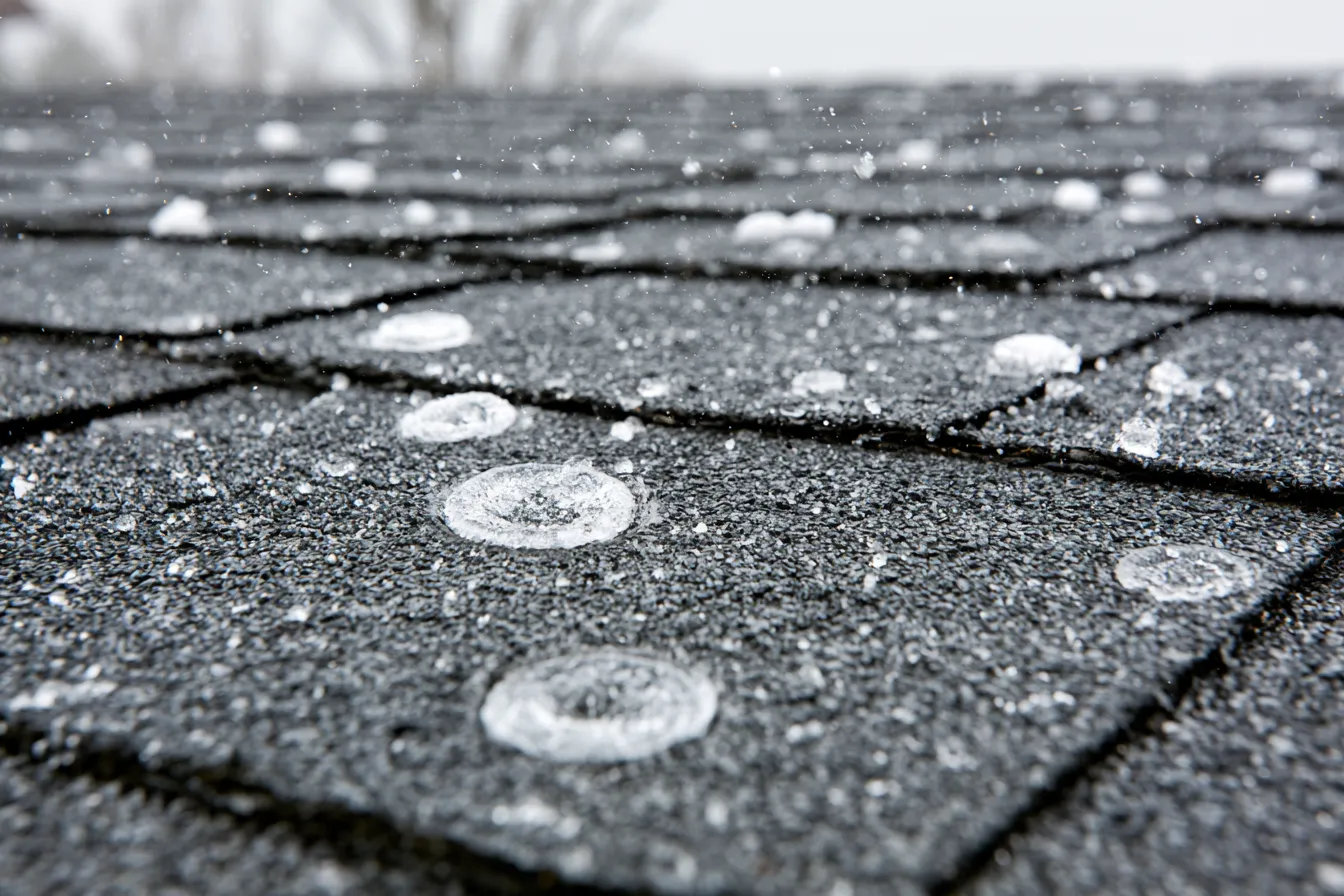
On April 20, 2023, the county record shows quarter-sized hail falling on Carrollton. Most homeowners who were here for it have not thought about it since, and that is exactly how hail damage works: the storm is loud, the damage is silent, and the bill arrives a year or two later dressed up as a mystery leak. This is a walk through what actually happens up there, using the public record for this county rather than a sales script.
What a hailstone does to a shingle, mechanically
An asphalt shingle is a fiberglass mat coated in asphalt and armored with mineral granules. A hailstone rarely punches through any of it. What it does instead is bruise: the impact fractures the mat under the surface and shakes granules loose around the strike point, the way a dent hides under intact car paint.
The fracture is the problem. Granules block ultraviolet light, and the mat is the waterproof layer; a strike compromises both at once. Nothing leaks that afternoon. Then the Texas sun works on the exposed spot through a summer or two, the fracture creeps, and the first ceiling stain shows up long after anyone connects it to a storm date.
The county numbers behind the pattern
NOAA's ledger for Dallas County shows hail falling on 23 separate days in the four years through 2026, 96 individual reports in all. The big headline was baseball-sized hail near Cedar Hill in the summer of 2023, but the file names Carrollton directly twice: the April 2023 strike, and quarter-sized hail near Trinity Mills that September, on the north side of town.
Two framing notes keep those numbers honest. County data describes the county, not any single street, so treat it as climate rather than a diagnosis of your roof. And the file lags roughly a season behind, so the newest storms are not in it yet. Even with both caveats, the conclusion holds: hail here is a schedule, not a fluke.
Why you cannot see it from the yard
A bruise the size of a quarter, thirty feet up, on a granulated surface, reads as nothing from the ground. Binoculars do not help much. The reliable ground-level evidence is secondary: fresh granules pooling at the downspout splash blocks, and dings in the soft metal, vents, flashing, gutters, sometimes the AC fins.
The metal is the honest witness. Aluminum takes and keeps a dent at hail sizes that bruise shingles, so marked metal after a storm is a strong signal the field took hits too. That signal is what a proper hail documentation pass then confirms or clears, slope by slope, on camera.
What checking early actually buys you
Three things, all of them about options. First, evidence quality: strike marks photograph cleanly when fresh and blur as they weather, and a dated photo set ties damage to a storm the county record can corroborate. Second, policy clocks: Texas claim deadlines live in your policy and most expect prompt notice, so damage discovered in year two starts the conversation badly. Third, small-repair economics: sparse strikes caught early are sometimes a modest repair instead of a claim at all.
The check itself is free and produces the same deliverable either way: the photo set and a written verdict. A roof that comes back clean is not a wasted visit; it is a documented baseline the next storm gets compared against.
After the next loud night, get the roof documented before the door-knockers arrive. The photos are free and they are yours. Call (972) 428-2019